Snake Ate Baby Birds but One Fell Out Will Momma Come Back
Predators Near the Nest: Bluebirds Weigh the Risks
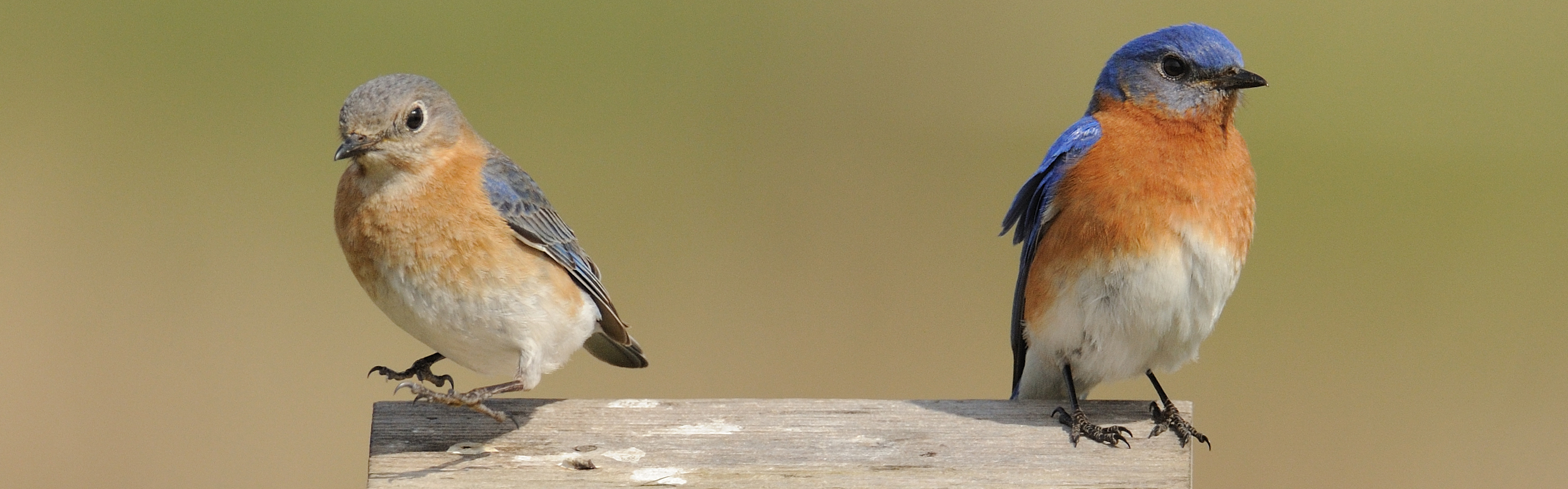 Photo © JanetandPhil
 past Robyn Bailey, NestWatch Project Leader
Oh, Rats!
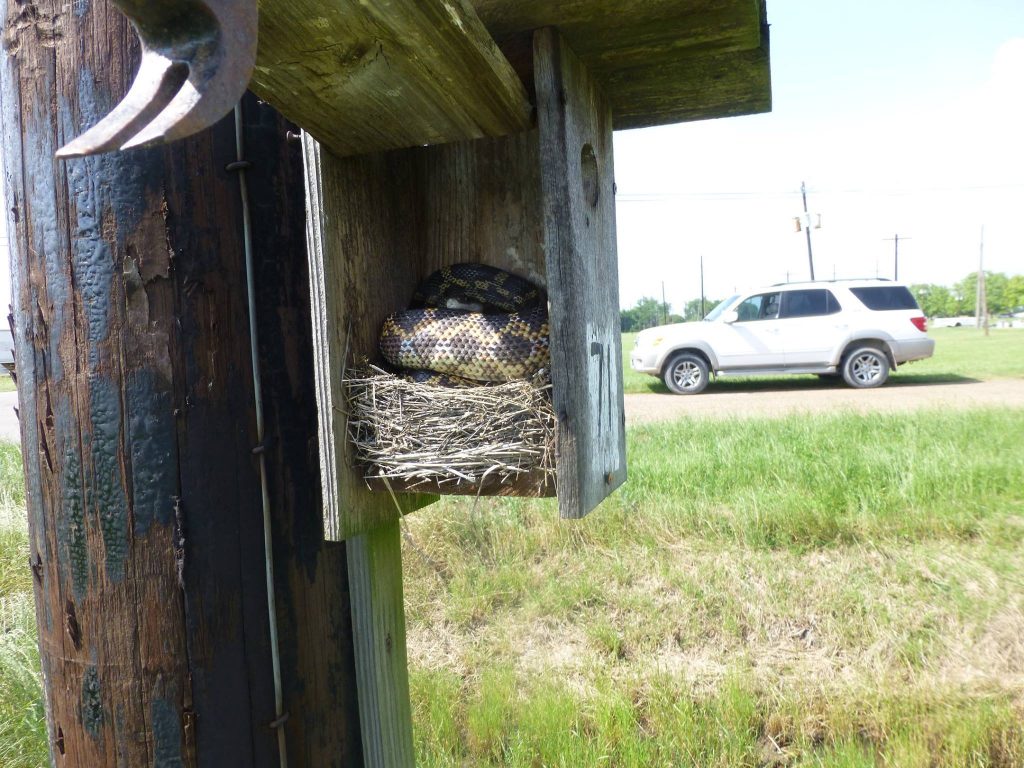
This rat snake found an Eastern Bluebird nest in Texas. Although named for their propensity to eat rodents, they are active climbers and will too prey on birds' nests.
To Stay or To Go?
At NestWatch, we often become questions from participants almost what could crusade nest abandonment. These questions are particularly likely to be asked by those who have spotted a predator in their surface area before long before the nest was abandoned. Information technology's logical to assume that if we see a predator in the area, the breeding pair has most certainly seen it too, and perhaps has fled to safer ground. Later all, predators are the leading crusade of nest failure for most species of birds, and birds are therefore responsive to seeing or hearing predators in their nesting area. Birds can respond to nest threats in several ways: mobbing the predator as a means of defending the nest; abandoning the nest and starting fresh in a new area; or staying committed to their nest in the face of the take a chance. Each decision has consequences and merchandise-offs that affect the evolutionary fitness of that individual bird. The earlier in the nesting cycle, the less "investment" the bird has fabricated in a particular nest, so choices made during the early nest-edifice stage are particularly interesting because they reveal the potential "costs" to birds and their ability to weigh pros and cons (e.g., is the predator likely to render?).
The Old Condom Ophidian Play tricks
Recently, researchers designed an experiment to investigate the reactions of Eastern Bluebirds to a mutual nest predator, the black rat snake (Stanback et al. 2018). They used a safety snake to simulate a predator on a nest box which contained a half-constructed nest, positioning the head in the entrance hole. The rubber serpent was left in place for fifteen minutes, and the nest was later on monitored for abandonment. The researchers were interested in determining if the bluebirds would abandon their nests after only one visit past a nest predator, or if they would stay invested in them. To command for any impacts of human presence, they presented command nests with a model of a Northern Cardinal, a harmless, non-predatory bird.
It is rather hard to study existent predators considering they are wild creatures that don't behave normally in the presence of people. While spooking birds with a rubber ophidian may audio mean, using simulated predators is really a technique that has been used for decades to study predator-casualty interactions, the development of defensive behaviors, and the benefits of cooperative breeding. Models of red squirrels, business firm cats, and owls take all been used to simulate predators in other studies.
By limiting the study to nests that were still under construction, the researchers avoided any potential harm to eggs or nestlings, while also allowing the bluebirds to make proactive choices (rather than reactive) about whether to carelessness a nest. Nest boxes were paired (two boxes were placed 33 feet apart) and so that birds could make up one's mind whether to stay, move to a nearby box, or get out the surface area birthday.
Also Shut For Condolement
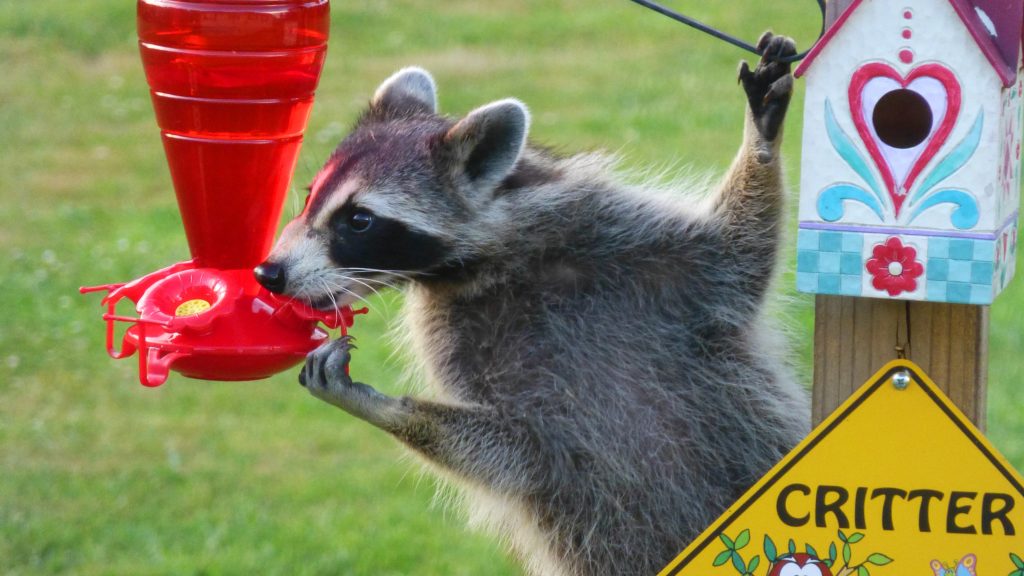
While a single visit from a predatory species may not deter nesting birds, you should consider relocating nearby food sources that would attract predators to nests. Frequent visits past a predator would near certainly discourage nesting.
Surprising Results
The results obtained past Stanback and colleagues were counter-intuitive. The bluebirds were no more likely to carelessness their nest after being presented with a rubber snake than they were when presented with a cardinal on their nest box. The bluebirds which were shown the cardinal even mobbed the cardinal in about equal numbers to those which were shown the snake. In fact, the majority of Eastern Bluebirds in the report continued to build their nest despite this visit by a nest predator. This suggests that if they really had eggs or immature in their nests, they probably would accept connected to attend the nest afterward a real predator sighting.
What does this mean? Well, information technology's always possible that the rubber serpent was not realistic plenty, and the bluebirds did non consider it a threat, but this would not explain why one-3rd of them mobbed the serpent (or why 12% mobbed the key, for that thing). Perhaps so many Eastern Bluebirds chose to go on their current nest sites considering even a half-built nest represents an investment of time and energy that is not hands recouped. Furthermore, nest cavities may be express, and a skillful nesting cavity on a practiced territory may still be better than a marginal nest cavity on a territory of unknown quality (even if such a cavity could be obtained afterward in the flavour). In whatever example, nest predators are commonly common in almost areas, and it may not brand sense to abandon a nest if yous're just as likely to run across a predator somewhere else.
Racer Versus Wrens
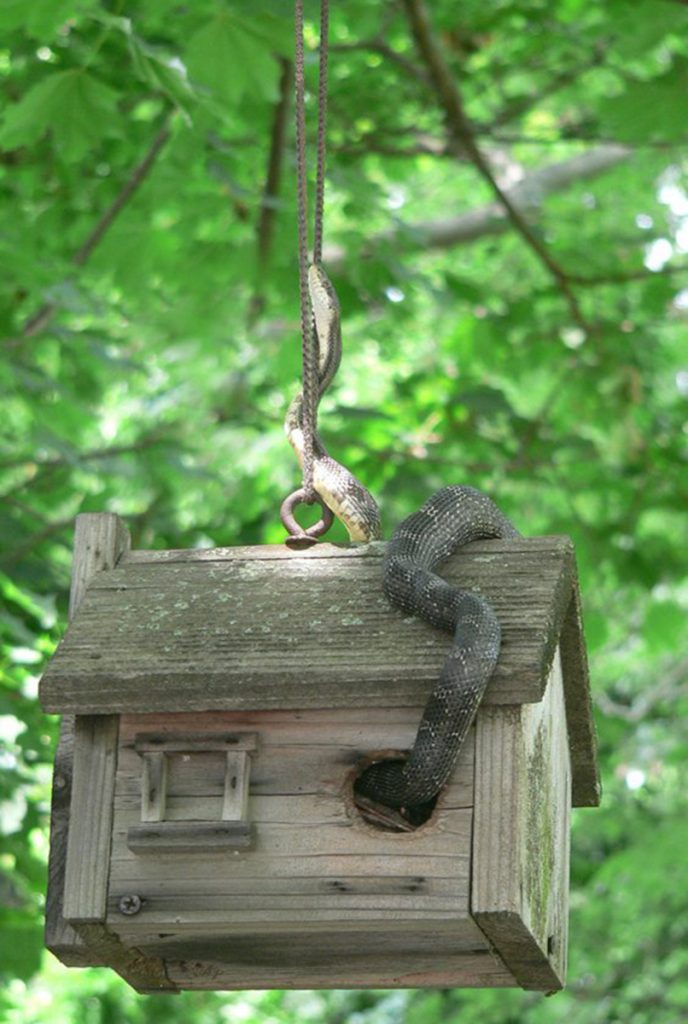
Once a predator has caused a nest to neglect, the nest site is unlikely to be used once more in the nigh hereafter. We'd recommend relocating such a box and attaching a predator guard.
When To Get out
A similar written report was conducted in 2006 by Fisher and Wiebe, in which Northern Flickers were presented with a model of a nest predator (red squirrel) at their nest cavity. Northern Flickers excavate their own nest cavity, and so abandoning the nest and excavating a new cavity would exist fifty-fifty costlier for this species than it is for Eastern Bluebirds. Similar the bluebirds, the flickers did non carelessness their nest site after being exposed to a predator mountain.
So to answer the common question of whether a predator observed well-nigh a nest box caused a nest to exist abased, the answer is "probably non" unless the visit by the predator was extensive and particularly disruptive. In some cases, birds are known to seek out areas with predators for nesting due to their suppression of other predatory species. Eggs and nestlings may be abandoned for other reasons, such as inadequate food, poor weather, or the death of the parent(s). However, parents are very likely to avoid a nest site that has previously failed due to predators (a reactive response); so if your nest box has stopped attracting birds, you may want to relocate information technology.
References:
- Fisher, R. J. and K. 50. Wiebe. 2006. Convenance dispersal of Northern Flickers Colaptes auratus in relation to natural nest predation and experimentally increased perception of predation take chances. Ibis 148:772-781. DOI: https://doi.org/10.1111/j.1474-919X.2006.00582.x
- Stanback, M. T., N. A. DiLuzio, A. Due north. Mercadante, and East. Southward. Diamant. 2018. Eastern bluebirds (Sialia sialis) exercise not abandon their chosen nest site in response to a unmarried visit by a nest predator. Wilson Journal of Ornithology 130(2):568-573. DOI: https://doi.org/10.1676/17-027.one
Filed under:
Source: https://nestwatch.org/connect/blog/predators-near-the-nest-bluebirds-weigh-the-risks/
0 Response to "Snake Ate Baby Birds but One Fell Out Will Momma Come Back"
Publicar un comentario